WHAT IS HABITABILITY?
Whether a place can continue to support a safe and dignified life.
Habitability is the lens through which we understand climate mobility. It asks not only who moves, but what it takes for people to live safely and with dignity, whether they stay or move.
THE DEFINITION
Habitability as a lens
Habitability means whether a place can continue to support safe, dignified life and livelihoods: water, food, shelter, income and services, and safety from climate events.
- A matter of degree, not a threshold. It can be lost gradually, well before a place is submerged or abandoned.
- Not fixed by geography. The same hazard may be survivable in one place and ruinous in another, depending largely on governance.
- A lens, not a legal status. Through it, climate mobility is how climate events show up in human movement and immobility.
FIVE THINGS TO KNOW
What the evidence shows
01
Most movement is internal.
Most climate-related movement happens within countries.
02
Many cannot move.
Many of the most affected people cannot move at all.
03
Climate rarely acts alone.
It interacts with livelihoods, housing, services, governance and conflict.
04
Moving can be adaptation.
Moving can itself be a form of adaptation.
05
Acting early costs less.
Resilience investment typically returns two to ten times its cost.
OUR APPROACH
The habitability arc
Our core question: what law and policy frameworks are needed to sustain a safe and dignified life and livelihoods in a changing climate? As conditions come under pressure, the mix of policy responses changes, but the objective stays the same: a safe and dignified life, by choice.
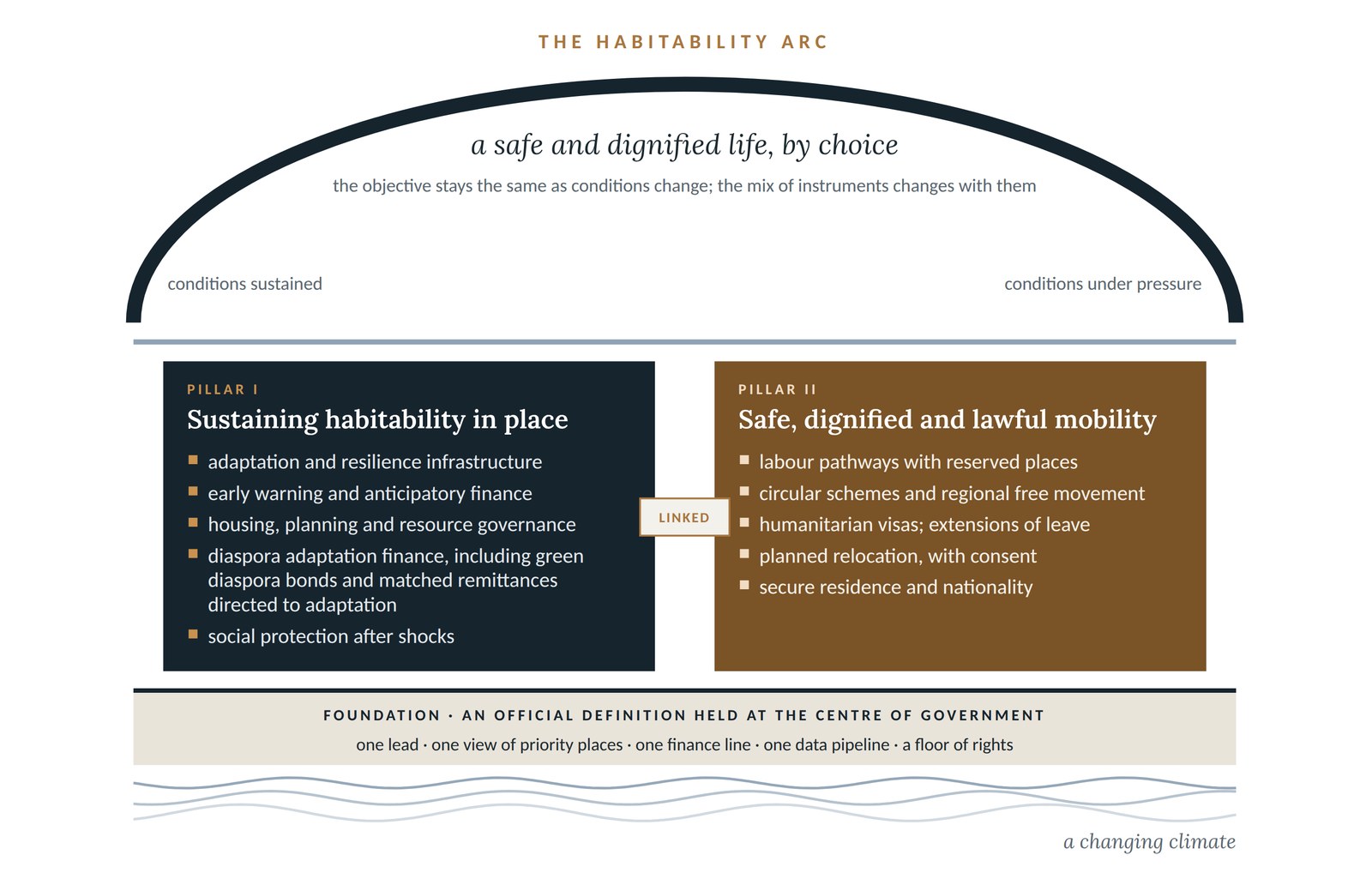
The two pillars are not alternatives, and neither is held in reserve for when the other fails. Where adaptation can no longer secure a safe and dignified life, safe routes to move become a way of safeguarding habitability.
BEYOND THE MIGRATION FRAME
Why “migration” alone misses most people
Public debate tends to frame climate mobility either as a cross-border migration wave to be managed, or as a humanitarian emergency after displacement. Both focus on movement, and on the point where it becomes visible.
That frame shapes funding and attention. It overlooks people who stay, people who cannot leave and the communities that receive newcomers, and it separates climate, migration, development and humanitarian work.
OUR PRINCIPLES
Five principles
- Habitability, not borders. Climate mobility concerns whether places and people can sustain life and livelihoods, including internal movement, immobility and receiving communities.
- Staying and moving in one framework. Instruments for sustaining habitability and for enabling mobility should be designed together, for the same places.
- Choice is the measure of success. Responses succeed when people can remain or move safely, on terms they help determine, including those who stay.
- Rights and communities first. Planned relocation is a last resort, carried out with communities rather than imposed on them. Pathways should be fair, non-discriminatory and protective of workers.
- Governments should own and define the agenda now. The centre of government should adopt an official definition and assign responsibilities across departments, before crises arrive.
HOW OTHERS CAN HELP
What you can do
- Use precise language: speak of climate mobility, including people who cannot move and the communities that receive newcomers.
- Connect climate, migration, development and humanitarian work around the same places.
- Involve affected communities in decisions about their own places and futures.
- Ask governments to adopt an official definition of climate mobility and to clarify each department’s role.
RESOURCES
Read more
POSITION STATEMENT · 2026
Habitability: the lens through which climate mobility should be understood
Download PDF
EXPLAINERS · 2026
Climate mobility, explained
Myths and realities, key terms, the basics, responsibility and the law.
Explore the explainers
GLOSSARY
Key terms
18 terms, from climate mobility to trapped populations, and the words to avoid.
Go to key terms